

A technical, guide to Value Engineering in construction UK. Learn the VE process, methods, lifecycle costing, MMC strategies, sustainability drivers, and best practices for delivering high-value projects.

Digital Takeoff vs Manual Takeoff
Compare manual and digital takeoff methods for UK construction. Learn the pros and cons, ROI considerations, time savings, and best practices for adopting digital takeoff tools in 2025.

Construction Estimate Cost in 2025 UK
Discover how UK construction costs will evolve in 2025. Learn about Tender Price Inflation, material and labour trends, typical per‑m² costs, and strategies to manage uncertainty for accurate estimates.

Material Takeoff vs Quantity Takeoff
Learn the difference between material takeoff and quantity takeoff in UK construction. Understand when to use each method, how NRM standards apply, and why accurate takeoffs improve budgeting and procurement.

Construction Estimating
In today’s competitive construction landscape, precision is not just a goal; it’s a requirement. A successful project is built on the foundation of an accurate and detailed cost estimate. As a leading construction estimating company, Fusion Assist provides developers, contractors, and project owners in the US and UK with the critical financial insights needed to plan, bid, and build with confidence.
Our expertise transforms complex project plans into clear, actionable data, ensuring your budget is realistic and your bids are competitive.
The Construction Project Cost Breakdown
Understanding what goes into the total cost of a project is the first step toward effective budget management. A professional estimate goes far beyond a single number; it provides a comprehensive breakdown of all anticipated expenses. At Fusion Assist, every estimate we produce includes a detailed analysis of the following components:
1. Direct Costs (The “Hard Costs”) These are the expenses directly tied to the physical construction of the project.
• Materials: A detailed quantity takeoff and costing for every item, from concrete and steel to wiring and fixtures.
• Labor: The cost of the skilled workforce required to execute the construction, calculated based on man-hours and prevailing wage rates.
• Equipment: The cost of purchasing or renting all necessary machinery, such as excavators, cranes, and scaffolding.
• Subcontractor Bids: The costs associated with specialized trades like electrical, HVAC, and plumbing.
2. Indirect Costs (The “Soft Costs”) These are essential expenses not directly incorporated into the physical structure but are critical for project execution.
• Permits and Fees: Costs associated with municipal or council approvals and inspections.
• Site Management: Salaries for the project manager, site superintendent, and other administrative staff.
• Overhead: General business expenses, including insurance, office rent, utilities, and administrative support.
• Design & Engineering Fees: Costs for architects, engineers, and consultants involved in the project.
3. Contingency No project is without its surprises. A contingency fund, typically 10-20% of the total direct and indirect costs, is a crucial allowance for unforeseen challenges, changes in scope, or market price fluctuations. We help you calculate an appropriate contingency to protect your project from risk.
How to Estimate Construction Costs: Our Methodology
Estimating construction costs is a sophisticated process that evolves with the project’s lifecycle. Our team is proficient in multiple methods to provide the right level of detail at the right time.
Stage 1: Order of Magnitude / Square Foot Estimate Used in the very early stages of planning, this method provides a ballpark figure based on the project’s size (square footage or metres) and intended use. It’s ideal for initial feasibility studies.
Stage 2: Systems & Assemblies Estimate As the design develops,
this more detailed method estimates costs based on major systems (e.g., the entire roofing system, the foundation, the HVAC system). It provides a more refined budget for decision-making during the design phase.
Stage 3: Unit Price / Detailed Takeoff Estimate
This is the most accurate and comprehensive method, forming the core of Fusion Assist’s services. Our estimators perform a meticulous “takeoff,” quantifying every single material component and labor task from the project blueprints. Each unit is then assigned a precise cost. This granular detail is essential for creating competitive bids, managing procurement, and controlling the final project budget.
The Construction Estimator:
Your Project’s Financial Strategist
What is a construction estimator? A professional estimator is far more than a number cruncher; they are a vital strategic partner for your project. The role of an estimator on your team is to:
• Provide Financial Foresight: By identifying and costing every element of the project, they create a clear financial roadmap from start to finish.
• Manage Risk: They identify potential financial risks, such as material price volatility or labor shortages, allowing you to plan accordingly.
• Optimize Budgets:
A skilled estimator can suggest alternative materials or construction methods (value engineering) that can reduce costs without compromising quality.
• Ensure Competitive Bidding: For contractors, our detailed estimates provide the confidence to submit bids that are both competitive enough to win the job and robust enough to secure a profit.
The team at Fusion Assist embodies this role, bringing decades of combined experience across a wide range of residential, commercial, and industrial projects in both North America and Europe.
Partner with Fusion Assist for Estimating Excellence
Whether you are validating a budget, preparing a bid, or seeking to control project costs, our expert team is ready to provide the clarity and accuracy you need.
To learn more about our commitment to precision and client success, please visit here.
For a detailed, data-driven estimate on your next construction project, contact us today.
• Request a Quote via our Online Form: Contact Us
• Speak with an Estimator:
o UK Office: (020) 7664 8623
o USA Office: (214) 308-1582
• Email Your Plans: info@FusionAssist.com
Plumbing Cost Estimation
Title: Plumbing Cost Estimator: From Bids to Detailed Quotes
Navigating the costs of a plumbing project can be complex. Whether you’re a homeowner planning a renovation or a contractor managing a large-scale build, a precise estimate is the foundation of a successful project. At Fusion Assist, we specialize in providing detailed, accurate, and transparent plumbing cost estimations. This guide will help you understand the bidding process, how to get a quote online, and what a professional estimate should look like.
Understanding and Winning Plumbing Bids
A plumbing bid is more than just a price—it’s a comprehensive proposal outlining the scope of work, materials, labor costs, and timeline. For contractors, submitting a competitive and accurate bid is crucial for winning projects. For homeowners, knowing how to interpret bids is key to choosing the right professional without risking under-quoted work or unexpected expenses.
Why are detailed plumbing bids so important?
- Clarity: A thorough bid eliminates ambiguity, ensuring both the client and the contractor are aligned on the project scope and deliverables.
- Budgeting: It provides a reliable financial roadmap, preventing costly surprises down the line.
- Comparison: It allows for an “apples-to-apples” comparison between different contractors, ensuring you’re evaluating them on the same criteria.
How Fusion Assist Helps You Succeed:
Our team has extensive experience in analyzing and preparing plumbing bids for both the UK and US markets. We help our clients:
- Create Winning Bids: We provide contractors with highly detailed material takeoffs and cost analyses to ensure their bids are both competitive and profitable.
- Evaluate Incoming Bids: For project owners, we can analyze bids you’ve received, highlight potential red flags, and ensure all necessary costs are included.
Don’t leave your next project to chance. A strong bid is your first step toward success.
How to Get a Plumbing Quote Online
Getting a precise plumbing quote from Fusion Assist is a straightforward process. A detailed quote requires detailed information. To help us provide you with the most accurate estimate, please have the following information ready:
Step 1: Gather Your Project Documents For the highest accuracy, we need your project plans. This includes:
- Architectural or design drawings
- Plumbing schematics or plans (if available)
- A written description of the project scope (e.g., new build, bathroom remodel, repiping).
Step 2: Define Your Scope Let us know the specifics of your project:
- Project Type: Is it a residential, commercial, or industrial property?
- Size: Provide the total square footage (or square metres) and the number of bathrooms, kitchens, or utility rooms involved.
- Material Preferences: If you have specific requirements for materials (e.g., PEX, copper, specific fixture brands), please include them.
Step 3: Contact Us Use our secure online form to upload your documents and send us your project details. Our team will review your submission and reach out to you with a comprehensive quote or to clarify any details.
Ready to start? Click Here to Get Your Free Plumbing Quote Online
Anatomy of a Professional Plumbing Estimate Template
Transparency is key to our process. A professional estimate should be easy to understand and leave no room for doubt. Here is a template outlining what you can expect to see in a detailed plumbing estimate from Fusion Assist.
Fusion Assist Plumbing Estimate
- Client Information: [Client Name, Project Address]
- Estimate ID: [Unique Estimate Number]
- Date: [Date of Issue]
- Project Summary A brief overview of the work to be completed (e.g., “Full plumbing rough-in for a two-story residential home” or “Cast iron drain replacement for a commercial kitchen”).
- Material Takeoff & Costs A detailed, itemized list of all required materials.
- Piping:
- Supply Lines (PEX, Copper, etc.): [XX feet/metres] – [$XX.xx / £XX.xx]
- Drain/Waste/Vent (DWV) Pipes (PVC, ABS): [XX feet/metres] – [$XX.xx / £XX.xx]
- Fittings & Connectors:
- Elbows, Tees, Couplings, Valves: [Quantity by type] – [$XX.xx / £XX.xx]
- Fixtures (If applicable):
- Sinks, Toilets, Showers, Water Heaters: [Quantity by type] – [$XX.xx / £XX.xx]
- Miscellaneous:
- Sealants, Adhesives, Hangers, Supports: [Lump Sum] – [$XX.xx / £XX.xx]
- Labor Costs A breakdown of the labor required to complete the project.
- Plumber/Fitter Hours: [XX Hours] @ [$XX.xx / £XX.xx per hour] = [$XXXX.xx / £XXXX.xx]
- Apprentice/Helper Hours: [XX Hours] @ [$XX.xx / £XX.xx per hour] = [$XXXX.xx / £XXXX.xx]
- Equipment Costs Any specialized equipment required for the job (e.g., trenchers, pipe threaders, inspection cameras).
- Permits, Fees, and Overhead
- Municipal/Council Permit Fees: [$XX.xx / £XX.xx]
- Contingency (Optional, typically 10-15%): A provision for unforeseen challenges.
- Overhead & Profit: A percentage to cover business operations and profit margin.
- Total Estimated Cost A final summary of all costs.
- Subtotal (Materials + Labor + Equipment): [$XXXX.xx / £XXXX.xx]
- Total (Including Fees & Overhead): [$XXXX.xx / £XXXX.xx]
Let’s Build Your Project Together
Understanding your plumbing costs is the first step. The next is partnering with an expert who can ensure your project is estimated accurately and executed flawlessly.
To learn more about our methodology and our team of experts, please visit our here
For a detailed estimate on your next project, contact our team today!
- Fill out our online contact form: Contact Us
- Call us:
- UK Office: (020) 7664 8623
- USA Office: (214) 308-1582
- Email us: info@FusionAssist.com

Mastering High-End Residential Construction Estimates in Manchester
Introduction: Beyond Volume Building in Manchester’s Prime Market
The high energy development of Manchester goes way beyond the commercial city centre. In its most desirable suburbs, through the tree-lined streets of Didsbury and Hale to the old town houses of Altrincham, a flourishing trade in top-end, niche residential development exists. It is a universe apart to the cookie-cutter designs of mass builders. It is an industry characterized by custom new construction, bold extensions and the tricky, sensitive re-modeling of period homes. The market presents opportunities to contractors as they are lured by the value of projects and the opportunity to build truly outstanding homes. But it is also a huge financial risk where one estimating mistake can mean the difference between a flagship success and a devastating loss.
The client in the targeted residential market is sophisticated, the materials are exclusive and the architecture is usually custom. A square-metre rate or a rule-of-thumb budget is not only inaccurate, but a direct menace to your profitability and reputation. An imprecise bid on a multi-million-pound luxury home renovation can lead to devastating cost overruns, fractured client relationships, and a project mired in financial disputes. On the other hand, the most potent tool you have is a highly detailed, transparent and accurate estimate. It creates instant confidence with the high-net-worth clients, shows how professional you are, and prepares the financial foundation of a successful, profitable, and smooth build. Effective construction cost estimating is not just a preliminary step; it is the cornerstone of success for Manchester contractors.
This is a handbook to the ambitious Manchester contractor who wants to conquer the very profitable world of bespoke residential building. We shall learn what makes precision in construction estimating in Manchester the key to this niche, how the specific challenges and essential parts of a successful bid can be dismantled, and how working with professional services such as Fusion Assist can give the precision and confidence to succeed.
The Main Benefits of Precision in Specialized Residential Estimating
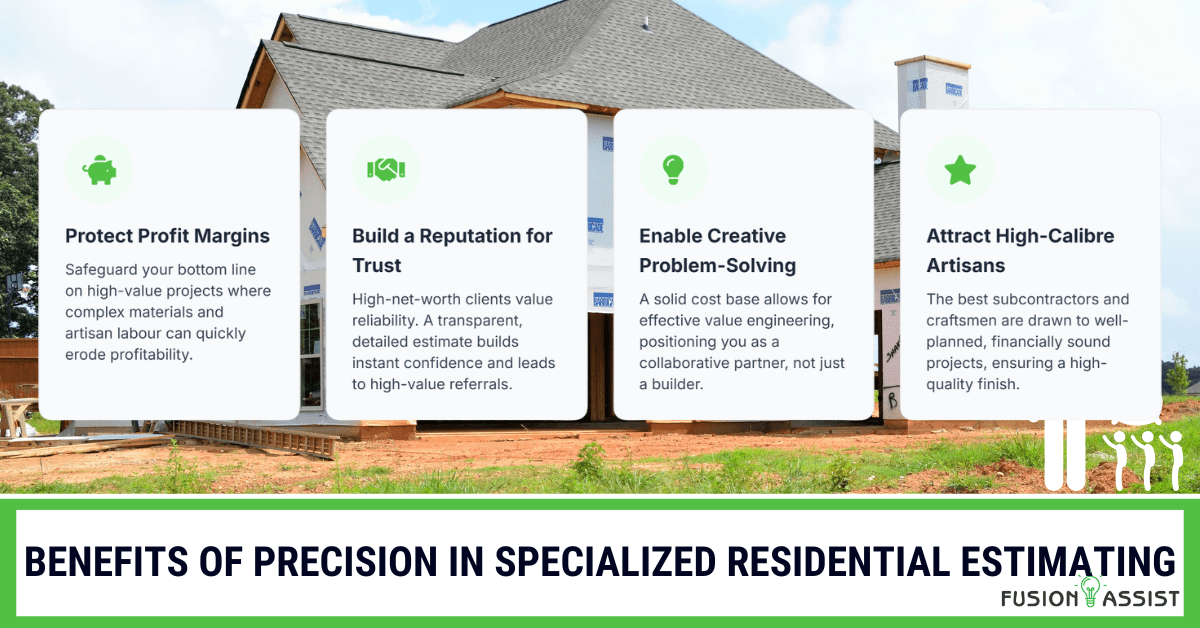
The payoff in the high risk world of custom home construction is enormous and extends well beyond safeguarding your bottom line when the estimate is accurate. It is a tactical method, which creates a strong and credible company.
Protecting Profit Margins on High-Value Projects
There is a general perception that high values of the project mean high profits. The fact is that in the real world, specialist materials, specialist labour and the complexity of the bespoke project can make margins surprisingly narrow. An accurate estimate serves as your major financial protection. When you cost each of the components of a project correctly, including the structural steelwork on a basement conversion and the final brass handle on your tailor-made wardrobe, you leave nothing to chance when it comes to your bid covering all the costs and ensuring you get the profit you desire at the outset. This eliminates the need for difficult conversations about cost increases and protects you from seeing your margin eroded by unforeseen expenses on any luxury home renovation.
Building a Reputation for Excellence and Trust
High-net-worth clients pay equal or more importance to transparency, reliability, and professionalism than the end price. An estimate well-prepared and presented is a strong statement. It reveals that you have a good grasp of their vision and have carefully mapped out its implementation. Such detailed description generates instant confidence and trust, which establishes a good start to the whole project. Your best asset in a referral market is a reputation of delivering on budget, and no surprises on the financial side, which will result in future commissions and referrals to custom home work in locations such as Didsbury and Hale.
Enabling Creative and Complex Problem-Solving
When both the client and the architect have a sound cost base to work on, it becomes a more cooperative and innovative process. With a proper breakdown of costs at a component level, you will be able to practice value engineering. You can collaborate with design team to propose alternative materials or procedures to fit the budget of the client without affecting the quality or the aesthetic purpose. This sets you not as a builder, but as a valuable problem solving partner in the project.
Attracting High-Calibre Subcontractors and Artisans
The most skilled craftsmen and tradesmen would prefer to work on well-considered, well-controlled work where they are sure to receive decent remuneration and in time. Projects with a solid financial base are of interest to the best subcontractors. After viewing an accurate and professional scope of work, they are able to quote their part of the work, and therefore, there will be fewer conflicts in the future. This will make you have the skilled hands that you require to provide you with the high quality finish that such projects require.
The Unique Challenges of Estimating Bespoke Residential Projects
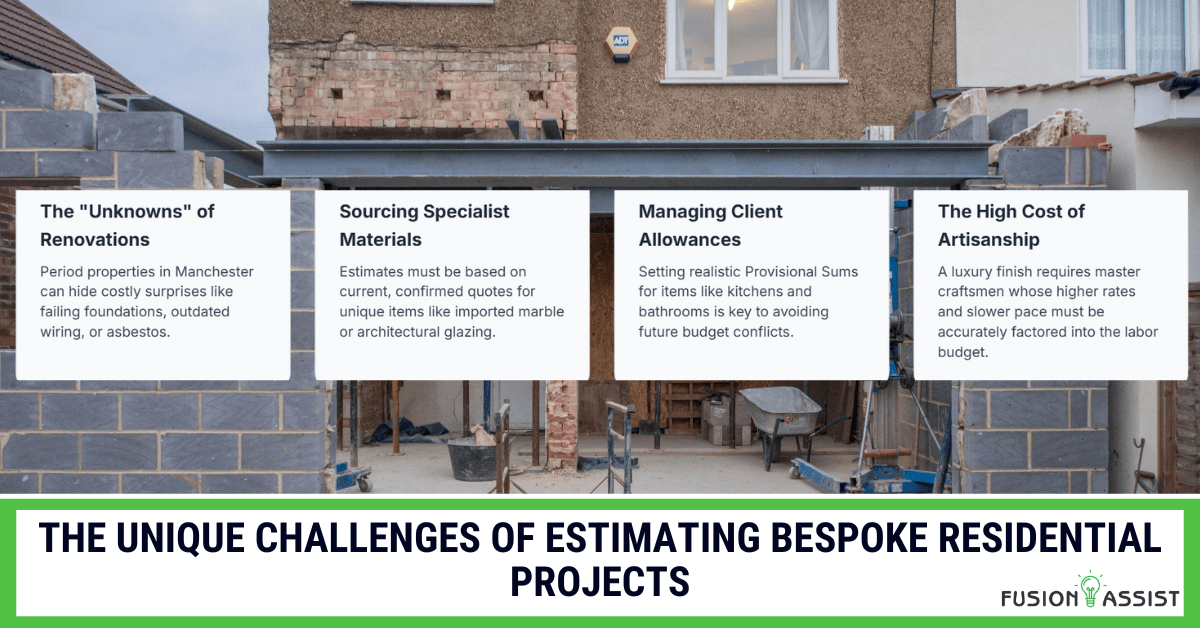
The method of estimating a one-off house or a complicated re-model is radically different to the cost of a standard new construction. It involves higher degree of research, vision and experience to be able to maneuver through the special set of challenges that this sector poses.
The “Unknowns” of High-End Renovations
Where the stock of Victorian and Edwardian properties in the city of Manchester is concerned, what you see is not what you get. The biggest challenge in any period property renovation is accounting for the “unknowns” hidden behind walls and beneath floors. This may be as simple as falling foundations and out-dated wiring to the presence of hidden asbestos or the necessity to carry out extensive structural repairs once the building has been opened up. An estimate should not thus only cover the work that can be seen but should also be based on a well calculated contingency to address such unavoidable concealed problems. To find out how to handle such complex scopes, such resources as How to Plan Large-Scale Construction Projects provide priceless frameworks.
Sourcing and Costing Specialist Materials
Bespoke projects are defined by their unique materials and finishes. This can include imported Italian marble, reclaimed timber flooring, large-format architectural glazing, or sophisticated smart home technology systems. The challenges here are twofold:
- Price Volatility: The cost of these specialist materials can fluctuate significantly and they often have long lead times.
- Sourcing: Finding reliable suppliers and getting firm quotes can be time-consuming.
Your estimate must be based on current, confirmed quotes from suppliers, not on historical data or guesswork. Utilizing a professional material takeoff service can be instrumental in managing this complexity.
Managing Client Allowances and Provisional Sums
In most prestigious projects, the customer will not have finalized on main products such as kitchen, bathroom sanitaryware, lighting and floor finishes at the period of the initial bid. These are managed with Provisional Sums or Prime Cost (PC) Sums. The difficulty lies on the realistic budgeting of such items. When the allowance is too low, the client will have a major overspend in future, which will lead to dissatisfaction. When you set your bids too high, your bid can be seen as uncompetitive. Adequate well-defined allowances should be put in place and this needs experience and clarity.
The High Cost of Skilled Labour and Artisanship
It takes master craftsmen not just general trades to deliver a luxury finish. The price of a qualified stonemason, a heritage plasterer or a master carpenter capable of scribing custom joinery is much more expensive than regular labour rates. They also work slower. An accurate estimate must account for these higher skilled labour costs (which can be £30-£50+ per hour or more) and the increased number of man-hours required to achieve a flawless finish.
Key Components of a Winning Bespoke Residential Estimate
An estimate of a specialized residential project is a multi-faceted document, which is professional and accurate. It does not leave any stone unturned and gives a clear and exhaustive picture of the whole project.
Component 1: The Meticulous Material Takeoff
This is your quantitative basis of your bid. It is much more than a number of bricks and mortar. A bespoke project takeoff is a detailed exercise of computing exactly how much of each and every material is required, the cubic metres of concrete to form the foundations, the number of specialist light fittings, the linear metres of shadow gap trim, down to the specific type of screws and fixings that will be needed to achieve a certain finish. This is where precision is paramount and where partnering with a professional material takeoff service like Fusion Assist can provide a massive advantage in speed and accuracy.
Component 2: Accurate Labour Costing for Specialist Trades
You have to get out of a mixed labour rate. Your tailor made home quote must be broken down with specifics on the various trades involved and the number of man-hours that each trade will take using the right rate of the market per level of skills. This implies that a complex mosaic laid by a tiler will be budgeted more than the labourer clearing the ground. It must also consider the non productive but necessary time of your site manager.
Component 3: Detailed Breakdown of Provisional Sums and PC Sums
The most important thing is transparency. In your estimate, all the provisional sums should be listed clearly. In each of them, you are expected to give a clear description of what the allowance covers. For example, for a kitchen PC sum of £50,000, you should specify that this includes the cabinetry, worktops, and appliances, but excludes the installation, plumbing, and electrical work, which are costed elsewhere in the bid. This clearness avoids any confusion and conflicts down the road.
Component 4: Accounting for Preliminaries, Overheads, and Contingency
These indirect costs are often what separates a profitable project from a loss-making one. Your estimate must accurately account for all of them, including:
- Preliminaries: Site setup, security fencing, scaffolding, waste removal, welfare facilities (toilets, canteen), and insurance.
- Overheads & Profit: A percentage to cover your company’s running costs (office rent, administrative staff, vehicle costs) and your desired profit margin.
- Contingency: A specific sum allocated to deal with unforeseen issues. For a complex renovation of an older property, a contingency percentage of 10-15% of the total build cost is a realistic and prudent figure to include.
Real-World Application: A Fusion Assist Case Study
The Client and the Challenge
A contractor with a reputation of quality work in Manchester was awarded the contract to tender a full gut renovation and 2 storey extension of a large Victorian villa in a Didsbury conservation area. The project entailed intricate structural remodeling to achieve a huge open-plan living area, the fitting of a unique glass and steel staircase, and a very high-end specification of all finishes. The client was very detail-conscious and the plans of the architect were elaborate. The contractor had to have a bid that is not only competitive but forensically detailed in order to win the confidence of the client.
The Fusion Assist Solution in Action
Recognizing the complexity and the high stakes, the contractor partnered with Fusion Assist. Instead of dedicating weeks of their own time to the estimate, they leveraged the specialist service:
- Forensic Digital Takeoff: Fusion Assist carried out a complete digital takeoff of the architectural and structural drawings including all the individual items, including the specialist conservation approved bricks, and the specific amounts of insulation that would be necessary to achieve current thermal standards.
- Real-Time Material Costing: They obtained current quotes on the high value items, the bespoke glazing system and the specified Italian marble of the bathrooms, which gave them a sound basis of cost.
- Detailed Labour Analysis: Care was taken to ensure that man-hours were properly calculated on complex items such as the formation of the new structural openings and the installation of the complex staircase to ensure that the labour budget was realistic.
- Professional Bid Documentation: Fusion Assist provided a detailed professionally formatted bid document. It distinctly divided the main build costs, the provisional amounts of the client-selection items, and a suggested contingency amount, which offered the final transparency.
The Result: A Confident Bid and a Flagship Project
The contractor had the Fusion Assist estimate, and this allowed them to bid with unmatched confidence. They could guide the client through the breakdown of the costs explaining each one of them. They were not the lowest bid but their professionalism and the open nature of their bid gave the project to them. This estimate was accurate and the project went well with no significant budget conflicts, making this contractor the standard of excellence in the high-end residential construction market in Manchester and providing a direct referral to another project.
Conclusion: Building Your Niche on a Foundation of Financial Accuracy
The estimate is your bond in the competitive but high-profit business of specialist residential construction in Manchester. It is what you give the client and the business budget. The basic distinction between putting together a portfolio of beautiful, profitable houses and fighting off the daily pressure of cost overruns and dissatisfied clients is getting it right. Exactness, detail, and openness are the roads to success in this niche. By adopting a precise approach to residential construction estimates in Manchester and the use of the strength of professional partners such as Fusion Assist, you will be guaranteed that every project that you secure is another project that leads to a more profitable, sustainable and respected future.
Ready to dominate Manchester’s bespoke building market? Swap risky guesswork for the pinpoint accuracy that wins flagship projects and protects your bottom line.
Contact us to build your next bid with confidence
Frequently Asked Questions (FAQs)
How much contingency percent is realistic when doing a high end renovation in Manchester?
On a large-scale refurb of an old house, a contingency of 10-15 per cent of the total build cost is sensible and acceptable to the professional. In the case of a tailor made new build on a clear site this could be brought down to 5-10%. The trick here is to tell the client that it is their money to use in case of unexpected problems and not a slush fund of the contractor.
What do I do about PC Sums (Prime Cost Sums) in my estimate such as kitchens and bathrooms?
The ideal thing to do is be as descriptive as possible. Instead of just “Kitchen – £50,000,” state “PC Sum for the supply of kitchen cabinetry, stone worktops, and integrated appliances based on drawings by [Kitchen Designer Name], model [Model Name].” It is important to make it clear that the total does not include VAT, delivery, and installation, which will be priced in the body of your estimate.
Why can I not simply apply a square metre rate to a custom residential job?
Square metre rates are averages of a great variety of projects. A custom-made house in Manchester by definition is not average. Depending upon the complexity of the structure, specification of the windows, quality of finishing and amount of bespoke joinery, the price can fluctuate significantly. A fancy kitchen in itself can be more expensive than the whole framework of a simple extension. The accuracy needed can only be attained by an element-by-element estimate.
How does proper estimating assist in the handling of client expectations?
Detailed estimate is an effective communication tool. It serves as a final authority on what is covered by the price. Going through the document with the client at the beginning of the project, you can specify the scope and the budget of each item clearly. This avoids the so-called scope creep and makes sure that should the client want to make any changes or specifications upgrades, they will know what it will cost them beforehand.
What is the most common estimating error contractors do when working on a custom home?
The most frequent and expensive to make is to underestimate the cost of labour of high-end finishes. The cost of a typical installation is usually planned by contractors, but in the case of expensive or challenging materials a perfect finish can require much more time. An artist who is a master tiler doing delicate mosaic tiles may do only a fraction of what a standard tiler would do in a day. Not taking this detailed, time consuming work into consideration will have a devastating effect on your labour budget.

Expert Prevailing Wage Estimation in Dallas, TX | A Contractor’s Guide
Introduction
The Dallas-Fort Worth construction business is a competitive one, and every contractor requires an advantage. It does not matter whether you are constructing skyscrapers in town or designing new suburbs, you cannot be the lowest bidder in order to win a project. This is even more complicated in public works, where a tangled network of so-called prevailing wage laws determines what you have to pay your workers. These regulations are a financial landmine and paperwork nightmare to many Dallas contractors. A minor error in a wage determination may cost large fines, stressful audits and even the next government work.
But what would happen if you could convert this challenge to a competitive advantage? Consider charting the course of prevailing wage estimates without a hint of apprehension, being compliant with the laws of the land and being the first stop to the money-making public projects. It is not only about staying out of punishment, but learning a system that can trick your rivals. A good, professional prepared prevailing wage estimate will safeguard your profits, gain the confidence of the agencies and win you more profitable work.
This is a guide to general contractors and subcontractors in Dallas. We will deconstruct prevailing wage laws, address the most common difficulties, and provide a clear way of ensuring you never get your estimates wrong. And we are going to demonstrate how working with a specialized service such as Fusion Assist can make the guesswork out of estimation, and you can go back to what you do best: building Dallas.
What Exactly Are Prevailing Wages in Dallas?
It is important to understand the concept well before we discuss strategy. Minimum wage is not prevailing wages. They consist of a certain rate of pay inclusive of fringe benefits that is determined by the government on workers in publicly funded construction projects. The aim is to ensure that the government contracts do not undermine the local labor standards. This makes a huge difference in a busy market such as Dallas.
Defining the Terms: Wages, Fringe Benefits, and Total Compensation
The current wage consists of two important components:
- The Basic Hourly Rate: This is the minimum hourly pay for a worker in a specific trade (like an electrician or carpenter) on a covered project.
- Fringe Benefits: This is an extra, employer-paid amount per hour that covers things like health insurance, retirement plans, vacation pay, and apprenticeship training.
As a contractor, you have to pay a total compensation package that is equal to or higher than the sum of these two figures. It is possible to pay all as straight wage or to mix a lower hourly pay with good benefits package. One of the most difficult aspects of prevailing wage estimation in Dallas is how to compute and apportion these fringe benefits.
The Legal Backbone: The Davis-Bacon Act and Texas State Laws
The source of these rules to Dallas contractors is normally two-fold:
- The Federal Davis-Bacon and Related Acts (DBRA): This is a federal legislation that covers construction contracts with the U.S government worth more than 2000. This act applies to you in case you are bidding on a federal project in Dallas such as work on a military base or VA hospital.
- Texas Government Code Chapter 2258: While Texas doesn’t have a statewide “Little Davis-Bacon Act,” this law requires that workers on state or local public projects (like for the City of Dallas) are paid the “general prevailing rate of per diem wages” for similar work in the area.
The first big challenge in the bidding process is to know what law to apply and determine the proper wage rates.
The High Stakes of Inaccuracy: Major Challenges for Dallas Contractors
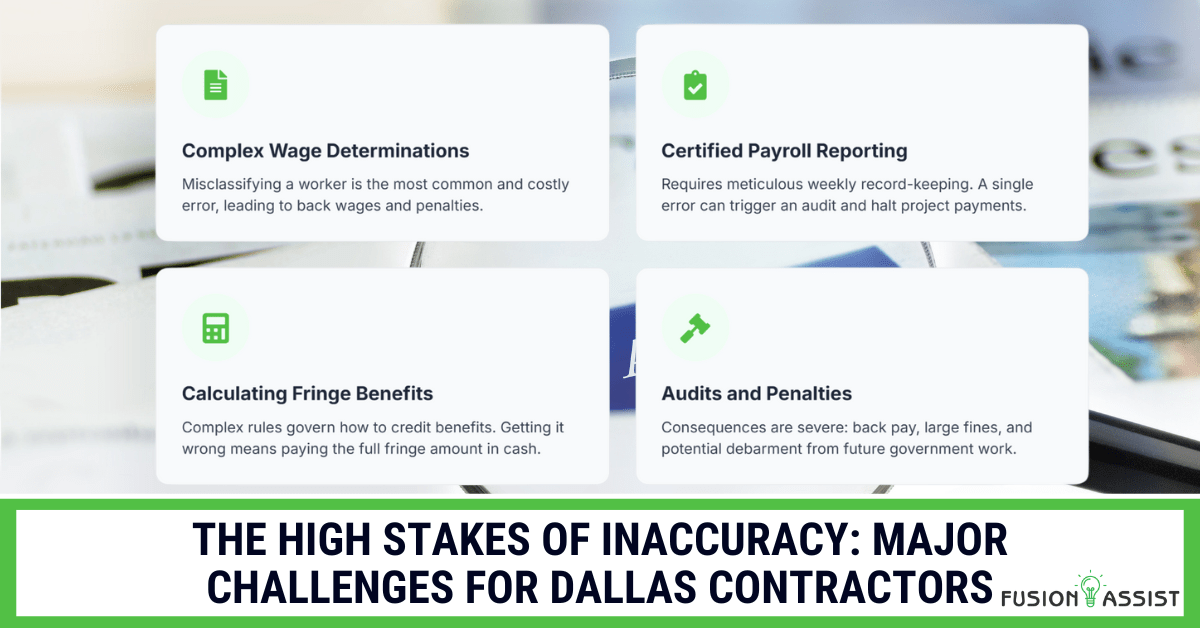 The concept of prevailing wages is quite straightforward, but its implementation is not. To an active contractor, administrative work can be too much. These are the greatest pitfalls that cause costly errors.
Challenge 1: Deciphering Complex Wage Determinations
A wage determination document contains the formal pay rates within a county in every job classification. Such documents may be lengthy and incomprehensible. One of the most frequent is the misclassification of a worker-paying a person the laborer rate when his or her responsibilities should be assessed as those of a carpenter. This one error compounded throughout an entire project can cost you thousands in back wages and penalties.
Challenge 2: The Nightmare of Certified Payroll Reporting
The prevailing wage jobs require impeccable record-keeping. The largest one is the filing of weekly certified payroll reports. These reports necessitate an explicit analysis of every employee in terms of their hours, job category, salaries and perks. A single error or a late filing may initiate an audit and stop your project payments.
Challenge 3: Calculating and Allocating Fringe Benefits
This is what most contractors fall short of. The credit on fringe benefits cannot be computed by dividing the amount you paid monthly on insurance by the number of hours you worked. It has certain rules and in case you do not get them right, an auditor can disallow your credit, and you will be forced to pay the entire fringe amount in cash.
Challenge 4: The Constant Threat of Audits and Penalties
Government agencies take wage compliance seriously. A worker complaint or a random check will initiate an audit. The consequences are severe:
- Payment of back wages to all underpaid workers.
- Significant financial penalties and fines.
- Withholding of contract payments until the issue is resolved.
- The debarment which removes you, up to three years, as a government contractor.
Your Solution Partner: Leveraging Fusion Assist for Flawless Estimation
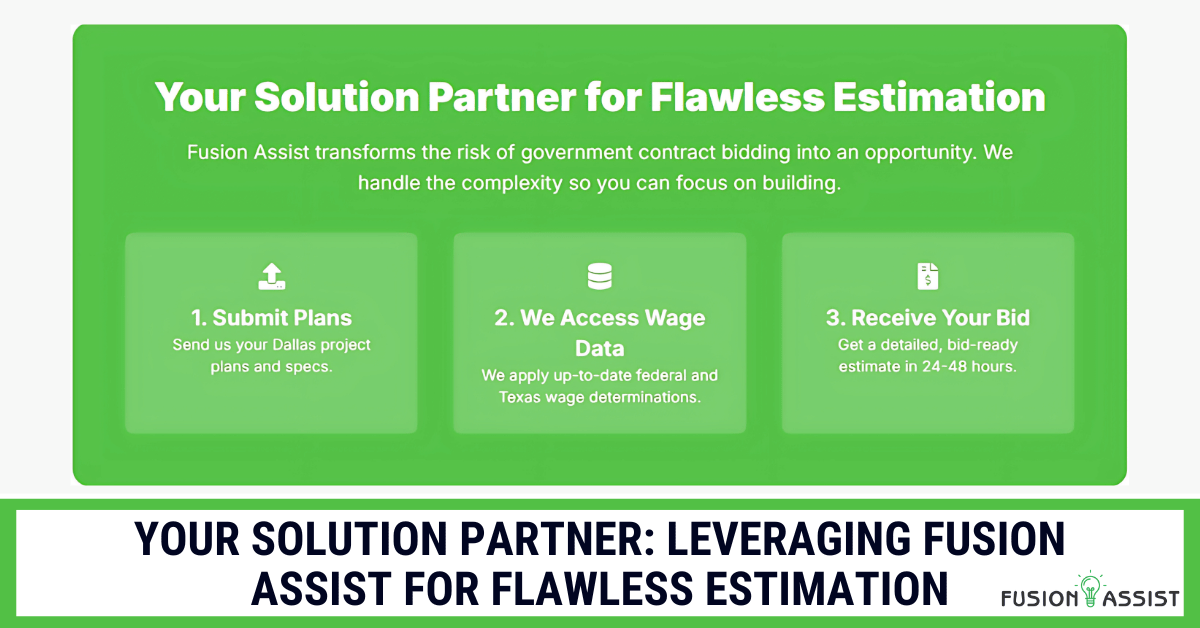 It is obvious, with such risks, guesswork is not an option. The complexity of the details to be provided demands a professional treatment. Hiring a professional estimation service provider such as Fusion Assist can transform the situation, and the risk of the government contract bidding in Dallas will become a thing of the past.
How Fusion Assist Transforms Your Bidding Process
You can leave the entire process to a group of specialists and devote your time to other issues instead of trying to understand wage determinations over several hours. We are a speed and accuracy driven process.
Step 1: Submitting Your Dallas Project Plans
The whole process begins as you submit your project plans to us. Our team promptly conducts the scope of work and the peculiarities of the Dallas area needs.
Step 2: Accessing Localized, Up-to-Date Wage Data
We employ an all-inclusive database of material and labor costs, the most up-to-date federal and Texas wage determinations in Dallas County. We align each work to the appropriate worker category and this is done with 100 percent accuracy.
Step 3: Receiving a Detailed, Bid-Ready Estimate
In 24-48 hours, you obtain the professional bid package. It is not a mere number, but rather an elaborate analysis of all the labor costs, in a format where your company logo appears and the report is ready to be submitted. This relieves you to work on client relations and project strategy.
Case Study: A Dallas Contractor’s Success on a City Park Project
Client
A mid-sized general contractor in Dallas.
Challenge
The City of Dallas issued a request of a multi-million dollar park project. The contractor was aware that the competition would be tough and they could not afford to make an estimation mistake that would burn their profit margin.
Fusion Assist Solution
The contractor forwarded the bid documents to Fusion Assist. We did a thorough take off and we cross referenced each activity with the right wage rate in Dallas County. It took the contractor two days to have a full, precise, and professionally branded bid.
Result
The contractor had a solid estimate and they placed their bid with confidence. They were awarded the contract, which they attributed to the fast and professional nature of Fusion Assist estimate that enabled them to stand out. They completed the project on a profit basis and without any compliance.
Key Considerations for Your Next Prevailing Wage Bid
The most effective option is to join forces with a specialist, yet it is beneficial that your team learns several important concepts:
- Worker Classification is Crucial: Never classify a worker on the basis of his or her job title..
- Don’t Forget Overtime Rules: Both federal and Texas laws require overtime pay (1.5x the base rate) for all hours worked over 40 in a week on a covered project.
- Document Everything: Meticulous records are your best defense in an audit. Keep detailed logs of hours, tasks, and benefits for every worker.
Conclusion: From Compliance Burden to Competitive Edge
A prevailing wage project is an enormous opportunity in the Dallas construction scene. Nonetheless, they require accuracy that can be overwhelming even to the most experienced contractors. Through a strategic approach, which consists of learning the rules, knowing the challenges and collaborating with expert partners, you can turn this complicated requirement into a strong competitive advantage.
Quit struggling with messy wage tables and paperwork. A proper professional estimate will create trust, safeguard your bottom line and distinguish you. Whether you need a bid-ready prevailing wage estimate to win one of the high-paying public works projects that define the future of Dallas or want to gain access to all the prevailing wage estimates needed to win the most bids, you can count on Fusion Assist to provide the bid-ready prevailing wage estimate that gives you the power to win more of the high-paying public works projects that define the future of Dallas.
Stop wrestling with complex wage determinations and start winning more profitable bids. Contact Fusion Assist to get your fast, compliant, and bid-ready estimate.
Frequently Asked Questions (FAQs)
What is the greatest error contractors have on prevailing wage jobs?
Misclassification of workers is the most prevalent and the most expensive error. The non-intentional but still direct violation is to pay a skilled craftsman at the rate of a general laborer, which will be detected during an audit and cause huge fines. It is of paramount importance that daily activities are aligned to the formal job categories.
Is it possible to pay my workers at the standard rate and cover the rest in cash?
No. Any form of payment should be recorded by official payroll. The use of side cash payments is unlawful, against the taxation regulations, and will lead to dire repercussions in the event that it is found out.
Is my subcontractors covered under prevailing wage laws?
Yes, absolutely. Being the prime contractor, it is your obligation to make sure that all the subcontractors within the job site are compliant. Failure to do so will turn out to be your liability.
What is the frequency of change of the prevailing wage rates of Dallas?
Wages are also revised on a regular basis in order to capture the local economy. The correct wage determination must be used based on the one you have in your particular contract and not an old one in a previous job.
How will an estimation service assist me with an audit?
A professional service such as Fusion Assist offers a straight forward, line by line breakdown of your work expenses. This third-party documentation by a professional, in an audit, proves your bid and payroll, and demonstrates that you have done your due diligence, and makes the process so much easier.

A Contractor’s Ultimate Guide to Union Wage Estimation in London
Introduction: Navigating London’s Unionised Construction Landscape
London’s skyline is a testament to relentless ambition, a dynamic canvas where architectural marvels and vast regeneration projects continuously reshape the city’s identity. From the financial powerhouses of the City and Canary Wharf to the transformative urban renewal in Nine Elms and the Olympic Park’s legacy in Stratford, the opportunities for construction contractors are unparalleled. Yet, beneath the surface of this thriving market lies a layer of complexity that can make or break a business: the city’s deeply entrenched and highly regulated unionised labour force. For any contractor aiming to build successfully in the capital, understanding the intricate web of union agreements is not just an administrative task—it’s a critical pillar of financial strategy and operational stability.
A significant portion of London’s skilled construction workforce operates under collective bargaining agreements managed by powerful unions like Unite and GMB. These agreements dictate far more than a simple hourly rate; they are comprehensive documents outlining everything from overtime premiums and travel allowances to pension contributions and specific working conditions. For contractors, navigating this landscape is a fundamental requirement for legal compliance, project harmony, and, most importantly, profitability. An error in calculating these multifaceted labour costs is not a minor oversight that can be absorbed. It is a critical flaw that can trigger a cascade of devastating consequences, including legal challenges, crippling industrial action, and budget overruns that can erase your entire profit margin. In a market as competitive as London, underestimating the true cost of union labour is a direct path to an unprofitable project and a severely damaged reputation.
This guide is for the savvy contractor who understands that winning a bid is only half the battle. The real victory lies in executing the project profitably, professionally, and without dispute. We will delve into why precise union wage estimation is non-negotiable, explore the benefits of getting it right and the immense challenges involved, and break down the key considerations every contractor must master. Furthermore, we will demonstrate how specialised partners like Fusion Assist are becoming an indispensable tool, leveraging technology and expertise to ensure your bids are not just competitive, but profitable and built on a foundation of accuracy.
The Main Benefits of Accurate Union Wage Estimation
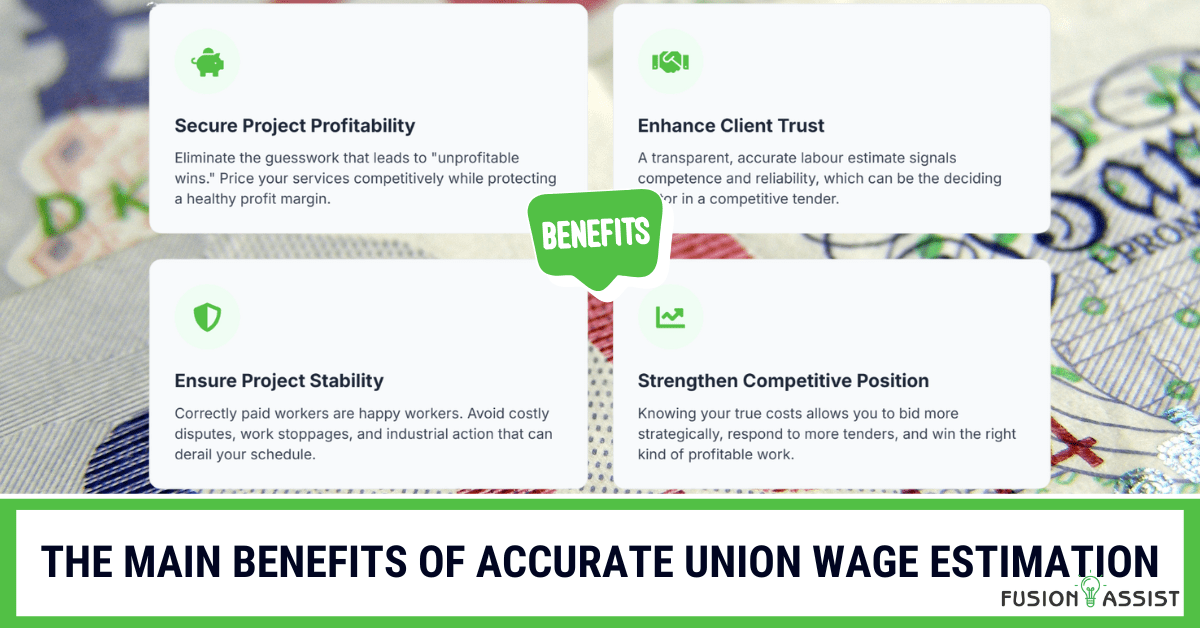 While the risks of getting it wrong are severe, the advantages of mastering union wage estimation extend far beyond mere compliance. Accurate labour costing is a proactive strategy that unlocks significant commercial benefits, enhances your company’s reputation, and builds a foundation for sustainable growth.
Securing Project Profitability
This is the most direct and crucial benefit. Your estimate is the financial blueprint for your project. When your labour costs—often the single largest variable expense—are calculated with precision, you can bid with confidence. You know exactly what your expenses will be, allowing you to price your services competitively while protecting a healthy profit margin. A precise estimate eliminates the guesswork that leads to “unprofitable wins,” where you secure the contract only to discover midway through that you’re losing money on every hour worked. It transforms your bidding process from a game of chance into a predictable financial exercise.
Enhancing Client Trust and Professional Reputation
In London’s top-tier construction market, sophisticated clients and developers are not just looking for the lowest price; they are looking for reliability and professionalism. A detailed, transparent, and accurate labour estimate is a powerful signal of your competence. It demonstrates that you have done your due diligence, understand the local labour laws, and are capable of managing the project without the risk of disruptive disputes. This builds immediate trust and can be the deciding factor in a competitive tender. A reputation for on-budget delivery and harmonious labour relations is invaluable, leading to repeat business and referrals to other high-value clients.
Ensuring Project Stability and Avoiding Disputes
Wage disputes are the primary catalyst for industrial action. When workers are paid correctly and on time, according to the letter of their agreements, the risk of work stoppages, strikes, or “go-slow” protests plummets. A project free from labour disputes proceeds on schedule, avoiding the catastrophic daily costs of site shutdowns, which can run from £50,000 to over £100,000 on major London projects. This stability is not only financially beneficial but also reduces stress on your project management team, allowing them to focus on construction rather than crisis management.
Strengthening Your Competitive Position
Contractors who master labour estimation can bid more strategically. Knowing your true costs allows you to identify which projects are the right fit for your business and which ones carry too much risk. Furthermore, when you can rely on a fast and accurate estimation process, particularly by partnering with a service like Fusion Assist, you can respond to more tender opportunities without sacrificing quality. This increases your chances of winning the right work—projects that align with your expertise and profitability goals.
The Main Challenges in Union Wage Estimation
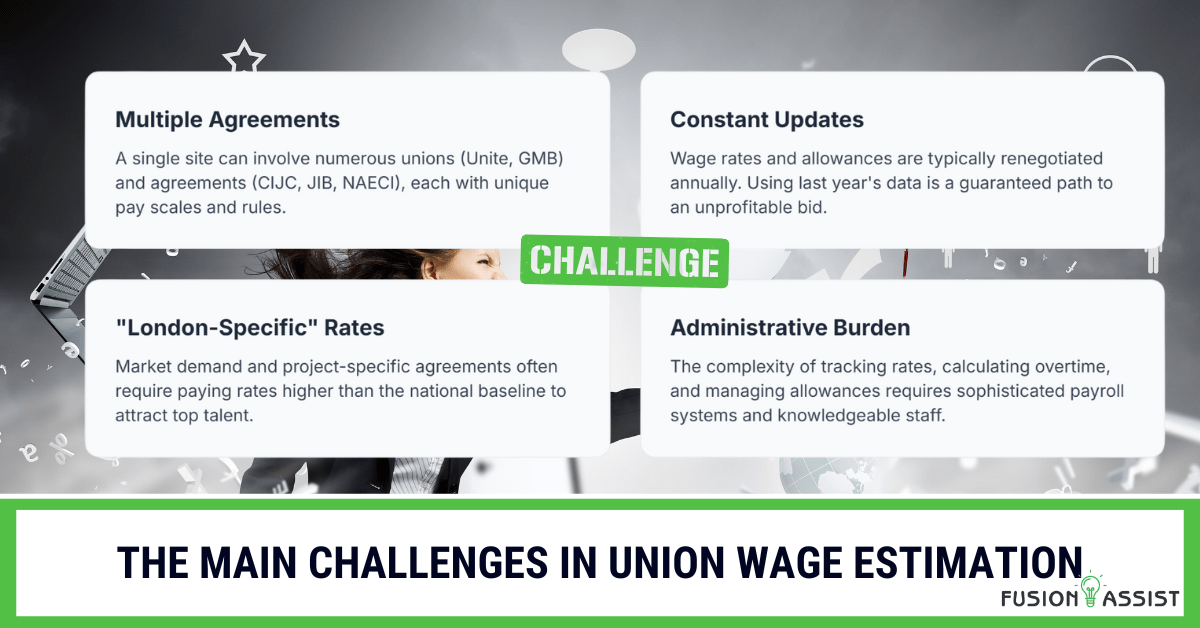 While the benefits are clear, achieving accurate union wage estimates in London is fraught with challenges. The complexity of the regulatory environment requires constant vigilance, deep expertise, and meticulous attention to detail.
Navigating Multiple, Overlapping Agreements
A typical large construction site in London is a complex ecosystem of different trades. You may have electricians governed by the JIB (Joint Industry Board) agreement, mechanical engineers and pipefitters under the NAECI (National Agreement for the Engineering Construction Industry), and general builders and civil engineers covered by the CIJC (Construction Industry Joint Council) Working Rule Agreement. Each of these documents has its own unique pay scales, allowance structures, and overtime rules. The challenge lies in correctly identifying which agreement applies to each worker and ensuring your estimate accounts for all the different variables simultaneously.
Keeping Pace with Annual and Ad-Hoc Updates
Union agreements are not static. Wage rates, travel allowances, and other financial entitlements are typically renegotiated annually. These changes are often announced only weeks before they come into effect. Using last year’s rates to bid on a project that will run into the next year is a guaranteed way to under-price your bid. A contractor must have a robust system for tracking these updates across all relevant unions to ensure their estimates are always based on the most current data.
The Ambiguity of “London-Specific” Rates and Project Agreements
While national agreements provide a baseline, the intense demand for skilled labour in London often means that effective market rates are higher. On major infrastructure or high-profile commercial projects, it’s common for a Project Agreement to be negotiated on top of the national agreement, stipulating enhanced pay rates or more generous allowances to attract the best talent and guarantee labour harmony. Failing to account for these unwritten rules or project-specific uplifts can leave your bid uncompetitive or your budget insufficient.
The Hidden Administrative Burden
The complexity of the calculations creates a significant administrative workload. Your payroll team must be able to accurately track different pay rates, calculate complex overtime scenarios, and manage various taxable and non-taxable allowances for every single employee. This requires sophisticated payroll software and knowledgeable staff. The time and resources dedicated to this administration are a real cost to the business that must be factored into your overheads. For a deeper dive into managing these overheads, a resource like “How to Plan Large-Scale Construction Projects” can provide valuable insights.
Key Considerations for Every London Contractor
To overcome these challenges, a compliant and accurate union wage estimate must be treated as a multi-faceted calculation. It requires a granular understanding of several core components that go far beyond a simple hourly rate.
Component 1: Foundational Pay Rates
This is the bedrock of your estimate. You must correctly classify every worker according to their trade and skill level as defined in the relevant agreement. Under the CIJC, for example, rates vary significantly:
- General Operative: The entry-level rate, around £15.00 – £17.00 per hour.
- Skilled Worker (e.g., Carpenter, Bricklayer): A higher rate, typically in the region of £18.00 – £22.00 per hour.
- Advanced Craft/Specialist (e.g., Steel Erector): Can command significantly higher rates, often exceeding £25.00+ per hour, especially in London.
These rates are non-negotiable minimums. For the most current figures, it is essential to refer to high-authority sources like the official Unite the Union or GMB websites.
Component 2: Overtime and Premium Hours
Projects in London rarely run on a simple 9-to-5 schedule. Your estimate must meticulously budget for the premium rates stipulated in union agreements, which are often calculated as:
- Time-and-a-half (1.5x basic rate): Typically for the first four hours of overtime on a weekday and for Saturday mornings.
- Double-time (2x basic rate): For overtime beyond the first four hours, late evenings, Saturday afternoons, and all hours worked on Sundays and Bank Holidays.
On a fast-track project with significant weekend work, these premiums can inflate your labour budget by 20-30% or more.
Component 3: Travel, Fare, and Subsistence Allowances
Union agreements mandate specific, often non-taxable, daily allowances that compensate workers for the cost and time of commuting. The CIJC agreement, for instance, has a detailed schedule based on the distance an operative travels to the site, which can range from £5.00 to over £20.00 per worker, per day. For projects requiring operatives to live away from home, a nightly lodging allowance (e.g., £45.00 – £55.00 per night) is also mandatory. These small daily additions accumulate into a substantial cost over the life of a project with a large workforce.
Component 4: Employer’s “On-Costs”
This is the most frequently underestimated category. For every pound you pay in gross wages, you must account for the additional mandatory costs of employment. These include:
- Employer’s National Insurance Contributions: A significant percentage (currently 13.8%) on all earnings above the secondary threshold.
- Holiday Pay & Entitlement: Workers accrue holiday pay for every hour they work. This is often calculated as 12.07% of their pay.
- Pension Contributions: Mandatory employer contributions under the UK’s auto-enrolment pension scheme.
- CITB Levy: A levy paid to the Construction Industry Training Board to fund industry-wide training. For larger employers, this is typically 0.35% of the total payroll for directly employed staff and 1.25% for subcontractors.
Collectively, these on-costs are a true cost multiplier, adding 25-40% on top of the basic hourly rate. Accurate estimation is the first step in legal compliance. To learn more, it’s wise to consult resources like “Avoiding Penalties: Compliance Tips for Prevailing Wage Laws.”
Real-World Application: A Fusion Assist Case Study
Theory is one thing, but the practical application of these principles under pressure is where specialist services demonstrate their true value.
The Client and the Challenge
A respected medium-sized contractor specialising in high-end commercial interiors won a tender for a fast-track, multi-floor office fit-out for an international bank in a landmark Canary Wharf tower. The project’s success hinged on a compressed 4-month schedule, requiring extensive night-shift and weekend work. The bank, as the end client, had a zero-tolerance policy for delays and labour disputes. The contractor knew that any error in their labour budget would not only destroy their profit margin but also irreparably damage their relationship with a top-tier developer.
The Fusion Assist Solution in Action
Facing immense complexity, the contractor partnered with Fusion Assist. Instead of spending weeks manually deciphering agreements, they uploaded the complete set of project plans and the proposed work schedule to the Fusion Assist platform. The process was swift and precise:
- Digital Takeoff: Fusion Assist’s estimators used advanced software to perform a detailed quantity takeoff, accurately calculating the man-hours required for every task, from installing partitions to complex MEP integrations.
- Database Application: Their proprietary database instantly cross-referenced the required trades with the correct governing agreements. It applied the London-specific JIB rates for the electricians and the CIJC rates for carpenters, plasterers, and general labourers.
- Complex Scenario Modelling: The system automatically modelled the 24/7 work schedule, accurately calculating the immense cost of all overtime, night-shift, and weekend premiums. It also factored in the correct travel and subsistence allowances for every worker based on the site’s location.
- Comprehensive Reporting: Within 48 hours, the contractor received a detailed, bid-ready report. It provided a granular breakdown of costs per trade, a transparent summary of all on-costs (NI, pension, CITB levy), and a total labour cost they could take to the bank.
The Result: A Profitable Win and a Strengthened Partnership
Armed with the Fusion Assist estimate, the contractor submitted a bid that was not the absolute cheapest, but was by far the most professional and transparent. The developer awarded them the contract, explicitly citing their confidence in the bid’s accuracy and the contractor’s ability to manage the project without labour issues. The project proceeded smoothly, with no costly disputes or budget revisions. This success not only resulted in a profitable project but also solidified the contractor’s reputation, leading directly to them being invited to tender for two more projects with the same developer.
Conclusion: Build Your London Business on a Foundation of Accuracy
In the high-pressure, high-reward world of London construction, your labour estimate is more than just a number in a bid; it is a declaration of your competence, a promise to your client, and a commitment to your workforce. It is the financial bedrock upon which successful projects are built. Getting it right is the single most important factor that separates the contractors who build a legacy of profitable, landmark projects from those who constantly struggle with disputes and financial distress. The complexity is immense, the risks are severe, but the path to success is clear. By embracing meticulous detail, staying current with regulations, and leveraging the technological advantage offered by specialist partners like Fusion Assist, you can turn the challenge of union wage estimation into your greatest strategic advantage. Stop risking your profits and reputation on guesswork, and ensure every bid you submit is built on an unshakeable foundation of accuracy, compliance, and confidence.
Turn London’s complex union agreements from a risk into your competitive advantage. Contact Fusion Assist for a fast, accurate, and fully-costed estimate to win your next project.
Frequently Asked Questions (FAQs)
What are the main construction union agreements I need to be aware of in London?
The most prominent is the Construction Industry Joint Council (CIJC) Working Rule Agreement, which is the foundational agreement for over 500,000 workers in the UK, covering most civil and general building trades. For electrical work, the JIB (Joint Industry Board) agreement is the definitive standard. For engineering and mechanical trades, such as pipefitters and welders on industrial-style projects, you will often encounter the NAECI agreement. It’s crucial to identify which agreement applies to each trade on your project.
How often do union wage rates and allowances change?
Typically, the core components of these agreements—wages and allowances—are renegotiated annually. The new rates usually come into force in late June or early July. However, ad-hoc adjustments can sometimes be made. It is a critical business practice to verify you are using the most current version of the agreements when preparing any bid, as using outdated rates from even a few months prior will guarantee an inaccurate and unprofitable estimate.
What is the CITB levy, and do I have to pay it?
The Construction Industry Training Board (CITB) levy is a mandatory payment for most construction employers, designed to fund industry-wide training and apprenticeships. If your total wage bill (which includes payments to both directly employed staff and subcontractors) is over a certain threshold (currently £120,000 per year), you must register and pay. The rate is 0.35% of your total payroll for direct employees and 1.25% of all payments made to subcontractors. It is a significant on-cost that cannot be ignored.
Can I use non-union labour on a major project in London?
While legally permissible, it is often commercially impractical and highly risky on large, high-profile sites in London. Most principal contractors and major developers have project-wide agreements to use only union-affiliated labour. This is done to ensure a consistent standard of skill, maintain site harmony, and prevent the demarcation disputes that can arise between union and non-union workforces. Attempting to use non-union labour on such a site can lead to your workers being denied access or can incite widespread industrial action from other unionised trades.
As a percentage, how much do all the “on-costs” add to the basic hourly rate?
As a reliable rule of thumb, you should budget for total on-costs to add between 25% and 40% to the basic pay rate. The exact figure depends on the worker’s earnings level. For example, a skilled tradesperson on a basic rate of £20.00 per hour does not cost you £20.00. Once you factor in Employer’s National Insurance (~£2.25), holiday pay accrual (~£2.41), and pension contributions (~£0.60), their true cost to your business is already approaching £25.26 per hour, even before considering the CITB levy or any travel allowances.
Why Accurate Commercial Construction Estimating in Atlanta is Crucial for Your Bottom Line
Introduction
In the dynamic Atlanta construction market, the skyline is constantly evolving. From sleek high-rises in Midtown to massive logistics centers near Hartsfield-Jackson, opportunities for commercial contractors are everywhere. However, there is a lot of risk involved with a high reward. In this competitive environment, the single most important factor that determines whether a project is a resounding success or a financial disaster is the accuracy of your initial estimate. An imprecise bid isn’t just a miscalculation; it’s a direct threat to your company’s profitability and reputation.
Many contractors believe that winning a bid is all about having the lowest price. While cost is a factor, savvy developers and project owners in Atlanta are looking for value, reliability, and professionalism. An estimate that is made swiftly, is imprecise, full of assumptions and gaps is a warning. On the other hand, a well-detailed, clear, and accurate bid creates instant confidence. It demonstrates that you have a deep understanding of the project scope, have accounted for all variables, and are capable of delivering on time and on budget. That is how you save your bottom line and develop a sustainable business.
This book is the guide to the aspiring commercial contractor in Atlanta, GA, who desires to get beyond merely winning work to winning the right work, profitably. We will explore why precision in commercial estimating is non-negotiable, break down the anatomy of a winning bid, and show how leveraging expert construction takeoff services in Atlanta, like those offered by Fusion Assist, can become your most powerful tool for growth.
The True Cost of an Inaccurate Bid
A wrong estimate leads to a chain reaction of issues that may cripple a project and your company. It is much more than a figure on paper, it is the financial basis of the whole construction. Once that foundation is weak then everything built on it is in danger.
Risk 1: Devastating Cost Overruns
This is the threat that is the most evident. If you underestimate the cost of materials, labor, or equipment, that money has to come from somewhere—and it’s usually your profit margin. The Atlanta market is a busy market, and the prices of materials and the availability of labor may change, and a minor error in your initial bid can end up costing you a lot by the time the project is completed. Avoiding cost overruns starts with a meticulously detailed estimate.
Risk 2: Damaged Client Relationships and Reputation
Think of a customer midway through a job with, say, 50 percent of the job done and telling the customer you need more money because there was an unexpected cost that you did not anticipate. This conversation instantly erodes trust and can permanently damage your professional reputation. In a city like Atlanta, where word-of-mouth is powerful, a reputation for change orders and budget issues can be devastating to future business.
Risk 3: Poor Project Planning and Execution
Your estimate is the plan of your project. It lets you know how to buy, how to staff, how to coordinate subcontractors. A wrong estimate results in a wrong plan. You may either order insufficient steel, book the wrong amount of electricians or have equipment idle. This on-site mess causes delays, wastage of resources and a stress-ridden team, which adds to the financial losses.
Risk 4: A Declining Bid-Hit Ratio
A habit of over-bidding will result in the loss of jobs. When you continually underbid you win the work but not the money. Neither of the two scenarios is sustainable. Accurate construction bids in Atlanta are about finding the sweet spot: a price that is competitive enough to win the work and comprehensive enough to ensure construction project profitability.
The Anatomy of a Winning Commercial Estimate- Atlanta
 A professional and accurate commercial estimate is a detailed, multi-faceted document. It does not leave any stone unturned and gives a clear transparent description of the whole project. These are the main elements that any high-quality estimate should have.
1. Detailed Material Takeoffs
This is your quantitative basis of your bid. It involves meticulously calculating the exact quantity of every single material needed, from the cubic yards of concrete and tons of structural steel to the number of light fixtures and linear feet of wiring. This is where precision is paramount and where using professional construction takeoff services in Atlanta can provide a massive advantage.
2. Accurate Labor Costing
You have to take into consideration the fully burdened labor cost. This is not only the hourly pay but also the payroll taxes, insurance and benefits of all trades involved. Moreover, you must estimate the required man-hours of each task properly, which should take into consideration the difficulties of commercial construction in a competitive market such as Atlanta.
3. Comprehensive MEP and Specialty Trades Analysis
Mechanical, Electrical, and Plumbing (MEP) systems are often the most complex and costly parts of a commercial build. A winning estimate requires a detailed breakdown from a specialized MEP estimating service. The same goes for other critical trades like structural steel, concrete, and masonry. An educated guess is a recipe to disaster.
4. Indirect Costs and Overheads
Direct material and labor are not the only elements of a profitable bid. You must accurately account for all indirect costs, including:
- Salaries of project management and administrative staff.
- Fees, insurance and permits.
- Such facilities as trailers and sanitation on-site.
- Renting of equipments and fuel expenses.
- A contingency fund for genuinely unforeseen issues.
5. A Clear and Professional Proposal
The closing estimate ought to be done in a formal manner. It must specify the entire work to be done, give inclusions and exclusions, give a projected timeline, and payment terms. This document is a direct reflection of your company’s professionalism.
The Fusion Assist Advantage: Technology-Driven Precision
 In the modern day market, manual takeoffs using scales and highlighters are inefficient, time consuming and subject to human error. The leading Atlanta construction cost estimators leverage technology to deliver speed and unparalleled accuracy. This is the core of the Fusion Assist service.
We combine the expertise of seasoned estimators with the power of advanced digital takeoff solutions. We have a procedure that will give you a competitive advantage and offer you bottom line protection.
Case Study: Winning a Competitive Office Renovation in the Buckhead District
Client
An Atlanta-based general contractor specializing in high-end commercial interiors.
Challenge
One of the major tech companies in the country was opening a new regional head office in a high-profile office building in the Buckhead area. The bid was highly competitive, and the client needed to submit a bid that was not only sharp on price but also exuded confidence and professionalism to win over the sophisticated client. They couldn’t afford to miss a single detail in the complex MEP and high-end interior finishing plans.
Fusion Assist Solution
The contractor sent the complete set of architectural and engineering plans to Fusion Assist. We have conducted a very detailed analysis with the help of digital takeoff software. We presented a full list of materials, including structural elements of the new layout and the exact amount of glass partitions, custom flooring, and sophisticated lighting. Our MEP estimating specialists broke down the HVAC and electrical systems, ensuring every component was accounted for.
Result
Within 48 hours, the contractor had a comprehensive, bid-ready estimate. The extent of details enabled them to present their bid with confidence, and they could answer the questions posed by the client accurately. Their bid was professional and the most comprehensive and this is why they were awarded the contract and not necessarily because they were the lowest. The accuracy of the initial estimate meant the project proceeded smoothly, with no costly change orders, cementing a strong relationship with a high-value corporate client.
Conclusion: Build Your Atlanta Business on a Foundation of Accuracy
In the high risk business of commercial construction in Atlanta, your estimate is your bond. It is the bargain that you give to your client and the financial plan of your company. Getting it right is the difference between building a legacy of profitable, landmark projects and struggling with the constant stress of cost overruns and unhappy clients. With the precision, the details of every component, and the power of expert services, all projects you win are one step toward the more profitable and sustainable future.
Stop leaving money on the table or risking your reputation with guesswork. Let Fusion Assist provide the accurate, detailed, and professional commercial construction estimates you need to thrive in the Atlanta market.
Frequently Asked Questions (FAQs)
What is the most commonly overlooked cost in commercial estimates?
Indirect costs are frequently underestimated. The laser-focused contractors tend to overlook the project management, insurance, on-site rentals, and administrative overhead costs and only focus on direct material and labor (the sticks and bricks). These costs can easily add 15-20% to a project’s total, and underestimating them can wipe out a profit margin.
What percentage do I put as contingency in a commercial pricing?
The common contingency amount of a commercial project is between 5-10 percent of the total direct costs. The percentage will vary depending on the complexity of the project. A simple warehouse construction could be around 5 percent and a complicated renovation of an old building in Atlanta could be 10 percent or more depending on the risk of unexpected problems.
What is value engineering and how does it relate to estimating?
Value engineering is the process of analyzing a project’s design to find less expensive alternatives without sacrificing quality or function. An elaborate estimate is important in this process. By having a precise breakdown of costs, you can identify high-cost areas and suggest alternative materials or construction methods (e.g., using a different type of structural steel or a more efficient HVAC system) that provide better value to the client.
How can I improve my bid-hit ratio?
Improving your bid-hit ratio isn’t about bidding lower; it’s about bidding smarter. This can be done by being selective in the projects you bid on, that is, ensure they are within your areas of expertise. Above all, it involves the submission of very professional and precise bids. The more detailed and transparent the estimate appears to the client, the more they will trust it and become more confident in choosing you even when you are not the lowest bidder.
Why can’t I just use square-foot pricing for a commercial estimate?
Square-foot pricing is useful for very early, conceptual budgets but is dangerously inaccurate for a formal bid. There is great variance in commercial buildings. A high-end office has vastly different MEP, interior finish, and structural requirements than a simple storage facility of the same size. The accurate cost of a certain project can only be determined through a component based estimate.